


Posted by Macron Will
28 Jul, 2026
How to evaluate flash liquidity software
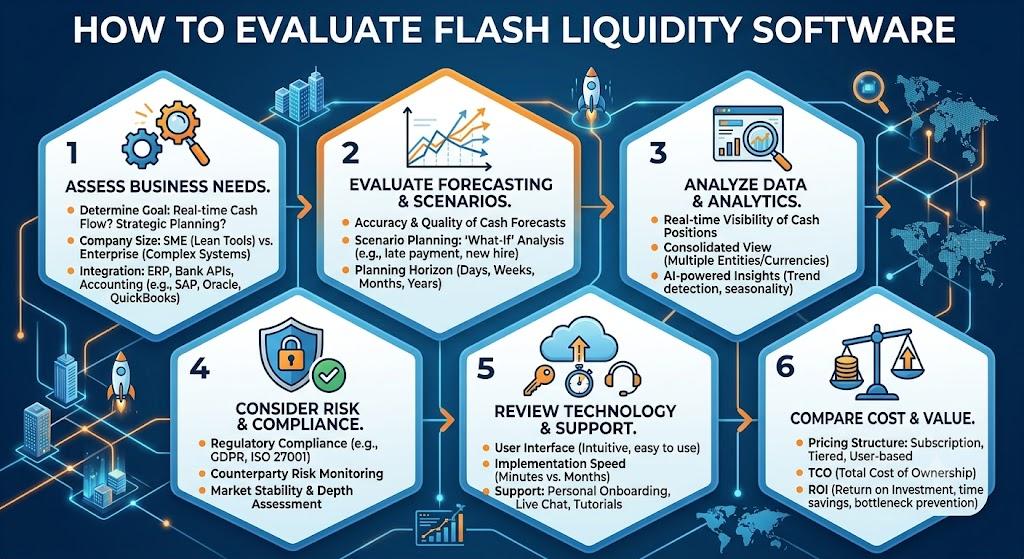
Evaluating flash liquidity software (or liquidity tech/bridges that enable high-speed, on-demand, or temporary liquidity provision) requires assessing technical performance, capital efficiency, risk controls, reliability, and economic alignment.
The term often appears in broker FX/crypto liquidity bridges, DeFi protocols (e.g., FlashLiquidity self-balancing pools, Flash Trade’s FLP pools on Solana, or Radix’s hybrid off-ledger/on-chain Flash Liquidity), and related market-making or arbitrage systems.
No single product is universally “best”—evaluation depends on your use case (broker aggregation, DeFi LP/trading, market making, or institutional execution). Use a structured checklist combining quantitative metrics and qualitative due diligence.
1. Liquidity Sourcing, Depth, and Pricing Quality
Number and quality of liquidity providers (tier-1 banks, non-bank MMs, or on-chain pools). Narrow feeds create concentration risk when one provider widens spreads or withdraw
Aggregated book quality: Does displayed depth hold under real size? Measure executable depth at key levels (e.g., within 0.5–2% of mid) and price impact/slippage for representative order sizes.
Pricing transparency: All-in spreads, last-look windows/hold times, reject rates, and whether quotes are firm. Prefer systems that report these clearly.
In DeFi contexts (e.g., pool-to-peer models like Flash Trade FLP): Utilization risk (LPs effectively take the other side of trades), fee sources (open/close, margin, swaps, liquidations), and balance incentives that discourage heavy imbalance
Test: Request live or historical quotes at your typical and peak ticket sizes across market conditions (including low-liquidity periods). Compare effective spread and implementation shortfall, not just top-of-book.
2. Order Routing, Execution Logic, and Pre-Trade Controls
Smart routing rules: Are they transparent and overridable? Opaque logic makes best-execution claims hard to verify
Pre-trade risk: Gross/net exposure limits, margin/credit checks, and clear behavior on limit breaches (rejects vs. requotes).
In intent-based or hybrid systems (e.g., Radix Flash Liquidity with Subintents): Matching quality, time bounds on pre-authorizations, and how solvers construct final on-chain transactions. Capital efficiency is a key selling point—market makers express liquidity off-ledger and settle only when matched
Test: Paper-trade or micro-pilot representative order flows; log fill rates, rejections, and slippage by venue/time of day.
3. Performance, Latency, and Resilience
Round-trip latency targets (measurable, not just averages—include tails). Extra milliseconds compound into slippage in fast markets.
Failover: Automatic across data centers or nodes; recovery time and testing frequency.
Uptime/SLA history and behavior under stress (volatility spikes, oracle issues, network congestion).
For on-chain/DeFi: Oracle reliability (primary + backup), circuit breakers, and execution latency (e.g., sub-50 ms claims on high-speed layers).
Test: Stress scenarios and historical recovery data. Monitor real-time microstructure signals if the software provides analytics (liquidity gaps, imbalance, toxic flow).
4. Connectivity, Integration, and Platform Coverage
Supported protocols (FIX, REST, WebSocket) and native connectors for your platforms (MT5, specific DEXs/CEXs, wallets, or OMS/EMS). Third-party plugins often break.
API quality: Rate limits, sandbox availability, documentation, and ease of programmatic use.
Multi-venue/cross-chain support and settlement speed/rails (especially important for stablecoin or multi-asset corridors).
Risk Management, Security, Oversight, and Economics
Risk & security: Independent audits (smart contracts or controls), penetration testing, credential encryption, and audit trails for every quote/order with exportable timestamps.
Reporting: Real-time dashboards for fill quality, LP performance, spreads, depth, and best-execution evidence.
Economics: Fee model (spreads, commissions, performance-linked vs. fixed), capital requirements/lock-up, yield sources for LPs, and total cost of ownership (including hidden latency or reject costs).
Resilience metrics: Time-to-recover after shocks, turnover/velocity of liquidity, and funding costs under stress.
Track record: Historical performance data, client references, and independent metrics (spread tightening, volume share, recovery times). For DeFi, examine TVL trends, actual vs. advertised APRs (including trader PnL effects), and smart-contract risk history.
Recommended -
Flash USDT Software Installation Guide and Instructions
Due diligence steps:
Shortlist 3–5 candidates via referrals and public metrics.
Request full documentation, live demos, API/sandbox access, and (where possible) token loans or test capital.
Run controlled pilots with your real flow sizes and corridors.
Negotiate SLAs, transparency clauses, and milestone-based or performance-linked terms.
Review legal/compliance alignment (especially for regulated brokers or institutional use).
Additional Context-Specific Considerations
Broker/FX liquidity bridges: Emphasize the five checks above—sourcing, routing, connectivity, performance, and oversight—to control hidden costs.
DeFi protocols (FlashLiquidity-style or FLP): Focus on automated arbitrage distribution to LPs, self-balancing mechanics, oracle robustness, and utilization/impermanent-loss-style risks. Verify on-chain transparency and historical fee accrual.
Hybrid systems (e.g., Radix Flash Liquidity): Capital efficiency for professional market makers (off-ledger expression + on-demand settlement via mechanisms like Instamint) is central; evaluate solver incentives, credit/vetting processes, and settlement finality.
General market liquidity assessment: Complement software evaluation with classic metrics—bid-ask spread (width), depth, resilience, and actual execution costs rather than quoted spreads alone.
Start with clear requirements (asset classes, ticket sizes, latency needs, regulatory constraints, capital efficiency goals). Quantitative pilots beat marketing claims. Conditions change rapidly in crypto and high-speed markets, so continuous monitoring post-deployment is essential. If you specify the exact product, use case (e.g., broker bridge, Solana FLP, Radix system), or chain, a more targeted evaluation is possible.
How to evaluate flash liquidity software